Gold stars

My mama told me when I was young, we’re all born superstars… So hold your head up girl and you’ll go far, listen to me when I say…

Born this Way, Lady Gaga

There’s a familiar knot in the plot line, when people who’ve found their calling reflect on their origins. It goes something like this “when I was young, my [mother / father / teacher / someone] told me I was good at [insert talent]”. Or, there’s a self realisation of this sort. A realisation that resonates and clicks in deeply.

And so it comes to pass.

Successful New York real estate agent Barbara Corcoran’s mother “pinned one thing on each kid… My thing was I had a wonderful imagination… and I fell for it, you know, and she’s right and I did have a good imagination, or at least maybe I learned to have it because of her.”

Journalist and professor Linda Villarosa had a great aunt who looked after her on Wednesdays and taught her to read “she said to me, you’re going to be a writer”.

Arnold Schwarzenegger goes to a small gym in Austria. He gets an award for a clean and jerk he did really well. That moment of positive feedback, sets him on a path and propels him forward.

In conversation with Shane Parrish on The Knowledge Project, Daniel Gross of Y Combinator and now Pioneer, describes these as “catalysing moments”. Experiences that lead to positive feedback loops, which in turn lead to where we are today.

The act of naming the talent is an important ingredient in the catalyst. With naming and categorising come shortcuts to understanding. With understanding, comes the confidence to take action.

In a world with lots of choice for lots of kids, perhaps kids with a strong sense of a particular talent have the advantage of an early knot in their plot line. Something that helps orient them and gives them a stronger sense of how they might fit in and contribute. Perhaps it makes the first (and next) steps clearer and easier to take.

In many cases, it probably doesn’t matter what the step is, or if it turns out to be the best step. There’s value in getting started, to get feedback – test, learn and adjust. As author and teacher Jim Collins argues, a key to success is not a single idea or one plan, it is the act of turning the flywheel, slowly gaining momentum and eventually reaching a breakthrough.

Without considering the counterfactual, without a randomised control trial, perhaps these moments of talent-naming aren’t material. Perhaps it’s a strategy that fails as often as it succeeds. But if there’s value in just getting started…

Try this at home [mums and dads]

Tell your kids something you’ve noticed they’re really good at, and add the ‘so what’. Perhaps your future robot boss is a brilliant constructor. Transforming the recycling into creatures and vehicles. With a talent like that, perhaps creating the machines or buildings of the future to transform how we live, is for them.

The idea isn’t to be deterministic, but to get the flywheel spinning.

Thank you to Shane Parrish (@farnamstreet) and Daniel Gross (@danielgross), Tim Ferriss (@tferriss) and Jim Collins (@level5leaders), Barbara Corcoran (@BarbaraCorcoran) and Linda Villarosa (@lindavillarosa) for inspiration and insights.
Q and A

American President, Franklin D Roosevelt, went on a fishing trip while the Battle of Britain raged and solved a problem baffling the bureaucracy.

…he came up with the whole idea of lend lease on a fishing trip because he was away from the turmoil of Washington where the bureaucratic structure couldn’t figure out how to lend money or lend supplies to England because of neutrality acts… A good yankee bargain… a simple thing, but no one could figure that out in Washington. 

Doris Kearns Goodwin, in conversation with Tim Ferriss

The fishing trip gave FDR time, but he came with a question.

Questions are places in your mind where answers fit. If you haven’t asked the question, the answer has nowhere to go. It hits your mind and bounces right off. You have to ask the question – you have to want to know – in order to open up the space for the answer to fit. 

Clayton Christensen via Jason Fried via Leisa Reichelt.

Like grit in an oyster, the question is the starter. The necessary irritant, and then there’s the white noise to work it through. The sort of time where ideas can tick over. Where you’re not being strictly productive, but your attention is your own. Runs, walks and showers. Especially showers.

Both sides of the ledger matter.

And Clayton Christensen’s framing points us to how much. It weaponises questions, making them agents of change, opening up fissures that weaken old beliefs and make space for new ones.

A question and time. Is that it? The secret to the-making-of-progress in ideas and the re-making of the status quo? Hiding in plain sight.

And it’s an alarming thought too, when technology captures and demands our attention. Turning it away from questions and transforming the white noise into active, but often  not productive time, for the-making-of-progress.

Try this at home kids

How can we create scaffolding in our everyday lives with our kids for questions that resonate and time to work them through?

Josh Wolfe of Lux Capital uses train trips. In conversation with Shane Parrish he talks about using train trips with his kids to deep dive on questions and topics. He also talks about using questions to plant seeds in his kids’ minds to encourage critical thinking.

And then here’s a different take on putting questions to work. You could try asking your child – What would Batman do?” (or insert name of alternative  hero of the hour.)  This one has the added benefit of supporting improvements in executive functions in five year olds (skills used for planning and doing tasks, organising, regulating behaviour, working memory, impulse control, and attention).

Thanks to Tim Ferriss (@tferriss) for his great interview with Doris Kearns Goodwin (@DorisKGoodwin), Shane Parrish (@farnamstreet) for his great interview with Josh Wolfe (@wolfejosh), Leisa Reichelt (@leisa) and Jason Fried (@jasonfried) for bring Clayton Christensen’s (@claychristensen) insight to us.

Editing: old school for iterating

‘Come with me. A superhero soon you’ll be’! Choose a costume: shield or cape? Boots to make a quick escape? What’s your power? Strength or speed? These are things all heroes need.

How to Be a Superhero by @SueFliess

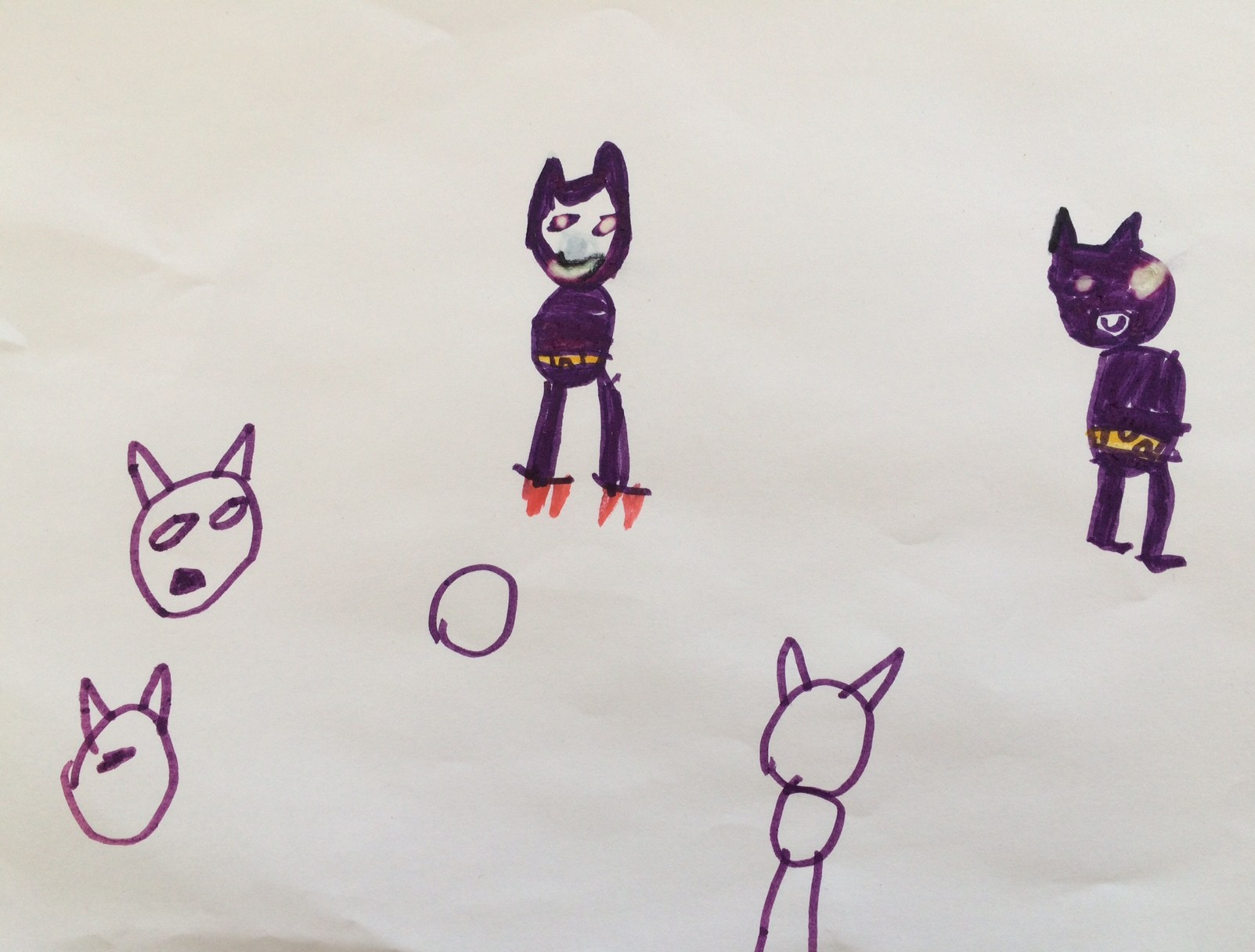
Getting your superhero just right takes a few goes.

IMG_3641

Kids can spend hours drawing. Getting what they see in their heads down on paper. Iteration is core business.

Writing seems to be approached differently. Perhaps because dabbling is more difficult for younger kids or, in a school context, there’s a draft or two, but that’s it. Hand it in. Onto the next thing.

Editing prose – drafting and redrafting, getting to heart of the matter – isn’t fashionable, but it’s incredibly valuable in business.  Consider how written material contributes to compelling brand identifies and value propositions.  When consumers are time poor and platforms are crowded, getting to the point is critical.

Also, experts who can also write well, have a real competitive advantage.  Equipped with great knowledge and the capacity to translate complex ideas into words that speak to people? Now that’s a real super power.

Yet editing is a skill rarely overtly taught in schools.

Try this at home kids!

Here’s an activity for older kids, taken from Jason Fried’s blog post The writing class I’d like to teach. It can help encourage kids to bring the approach they often bring to drawing, to writing.

Pick a topic, any topic, and write a three page version, a one page version, a three paragraph version, a one paragraph version, and a one sentence version.

Each step requires asking ‘What’s really important?’ That’s the most important question you can ask yourself about anything….Whittling it all down until all that’s left is the point.

Jason Fried, co-founder and CEO of Basecamp in episode #329 of The Tim Ferriss Show and in a Signal v. Noise.

Thanks for the inspiration @jasonfried and @tferriss.