

Once upon a time, waiting for an Uber

In the first season of StartUp, Alex Blumberg talks about an early pitch to Chris Sacca, for what would later become Gimlet Media. On a sidewalk, under pressure, it doesn’t go well. Chris Sacca steps in and translates. He plays the conversation back with the contemporary constraint “in the two minutes it’ll take for an Uber to arrive”.  Compelling and to the point, its pitch perfect.

The ‘pitch’ is a modern form of storytelling. And the pitch itself can be enough; to win investors, partners, even customers. In business, as in life, stories matter. A lot.

The value of authenticity and narrative arc are widely acknowledged in shaping how compelling a story is. In ‘A Debate with Malcolm Gladwell from WorkLife with Adam Grant’, however, Malcolm Gladwell and Adam Grant focus-in on another quality of storytelling “interestingness”.

For Malcolm, “…that quality of being specific and being able to illustrate your larger points with… precision is the quality of what makes something interesting.”

For Adam, interestingness has its origins in a certain kind of… pause. Drawing on the work of sociologist Murray Davis he suggests that “If someone just affirms your assumptions, you don’t get curious, you don’t get intrigued, there’s no surprise… when you’re interested is when it’s like ‘huh’, that’s the opposite of what I would have thought, or that’s different from what I would have believed”.

So if M. Sanjayan’s right and storytelling is a way to rule the world, well that’s a craft to master. Time to take “Once upon a time” and crank up the ‘interesting’.

Try this at home kids!

  1. Pocket full of stories: without little eyes watching, pop four or five everyday items into the pocket of a coat. This is now the storytelling coat. Get the kid(s) to put it on, check their pockets and then tell a story incorporating the objects they find.
  2. First half / second half: begin by telling a story out loud. Right after you get to a critical point, stop and let the kid(s) take over.
  3. The pitch over dinner: at breakfast time, ask the kid(s) to keep an eye out during the day for a ‘problem’ they encounter and to come to dinner with an idea to solve it.  The problem doesn’t need to be enormous – a top that’s hard to get on, pens and socks that keep disappearing – anything that doesn’t go smoothly will do.

In each case, encourage the kid(s) to make the story as interesting as possible. Talk about what might help with this. Perhaps by incorporating a real story, something they have experienced, getting very specific or getting characters to do the opposite to what you might expect.

Thank you for the inspiration Alex Blumberg (@abexlumberg), Chris Sacca (@sacca), Adam Grant (@AdamMGrant), Malcolm Gladwell (@Gladwell), Guy Raz (@HowIBuiltThis) and M. Sanjayan (@msanjayan) ℅ Tim Ferriss (@tferriss). All masters of their particular storytelling craft.

Postscript

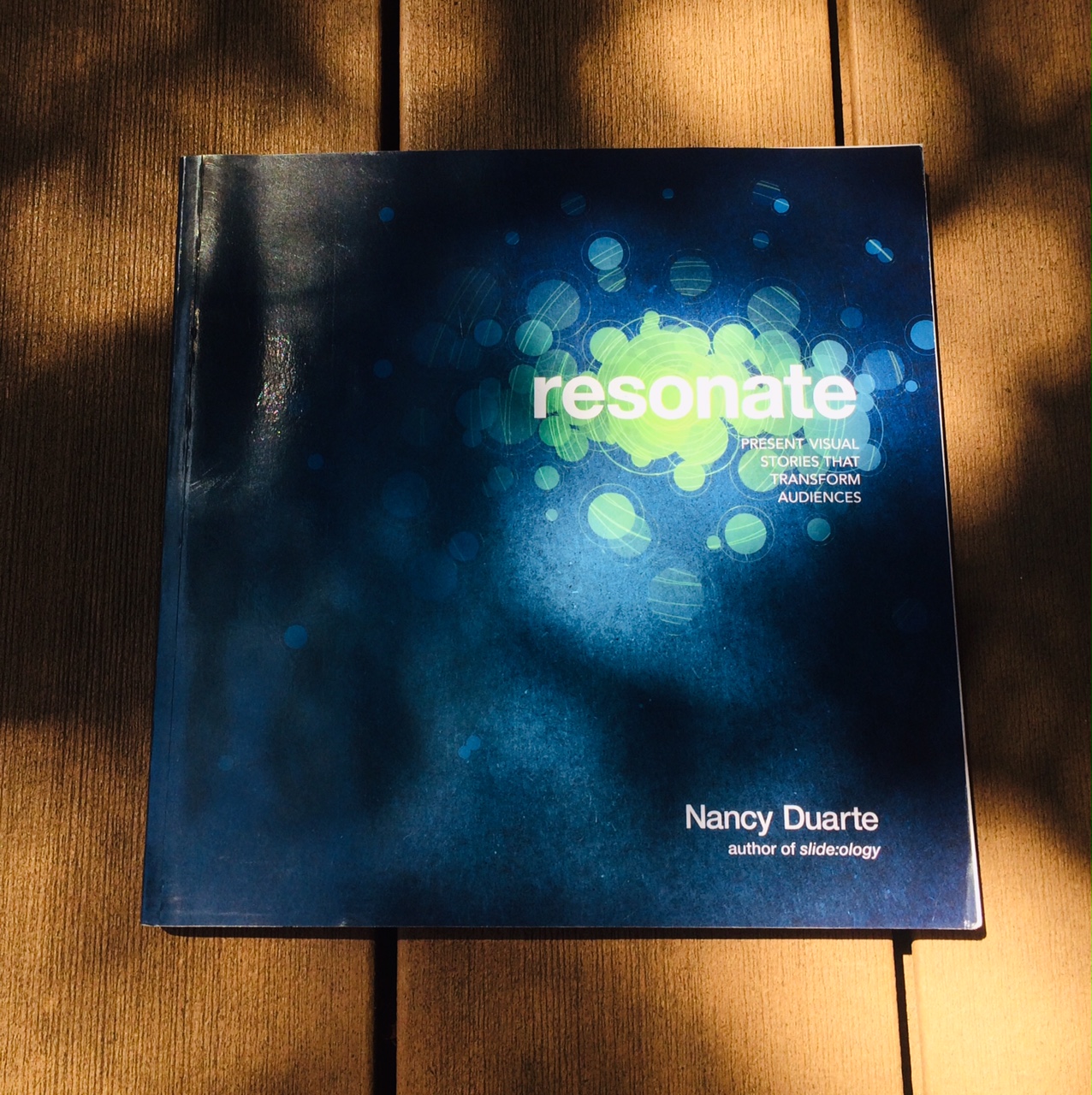
For more inspiration, Nancy Duarte‘s Resonate is a masterclass, and modern take, on “Once upon a time…”.
Kan ban worry / build confidence

Agile methods like Kanban are awesome.

Kanban can help with team planning, task management and delivery. Kanban is Japanese for ‘visual signal’ (among other things), and it certainly is.

Get your Post It notes and Sharpies ready. If you’re not already engaged in a battle for wall space, Scrum, Kanban and their agile variants are coming to a workplace near you.

Agile methods can help teams do some things that can be particularly difficult, including:

  • identifying and staying focused on specific goals;
  • breaking goals down into steps and ultimately very do-able (and much less intimidating) tasks;
  • providing a sense of progress and achievement – as coloured Post-it notes (or digital cards) move across the board from ‘to do’, to ‘doing’ and then ‘done’; and
  • providing a stronger sense of ownership and control.

Kids (and anyone really) can worry or feel unsure about how to go about achieving a goal or task, from a homework assignment to learning a new skill.  Kanban can help. Practical, visual and logical, Kanban might be just the thing to bring a goal into focus and help future robot bosses figure out how to get there.

Try this at home kids! 

Kanban with kids works really well. This article by Rafa Garcia for Productive! Magazine has some great tips.

Building a basic Kanban board is a great place to start.

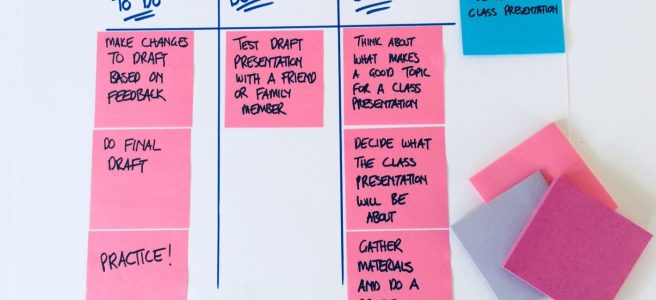
  • A whiteboard, chalkboard or few pieces of paper stuck together work just fine. Here are some examples.  It doesn’t need to be perfect, just three columns with the labels ‘to do’, ‘doing’ and ‘done’ and a section at the bottom somewhere for an ‘icebox’ (where you pop things that need to be done at some point, but don’t need to be tackled right away).

Then, next time your future robot boss is concerned about something or has an excellent idea for an age-appropriate entrepreneurial venture – try kanbaning it.

Start with the the goal or thing your future robot boss is working towards (for example – doing a great job on an upcoming class assignment – see picture). Write it down.  Be as specific as possible. Next, break down the goal into the steps needed to get there, writing each one a separate Post-it note.

Now it’s time to take action – specific, do-able and Post-it-noted actions – to reach that goal!

Good luck (and let us know how you go, we’d love to hear from you).

Post script – Here’s a great article from  the Harvard Business Review on the rational for breaking task down into smaller steps until it feels doable.


mattering marinade

These posts won’t all circle back to Adam Grant, but we have really enjoyed his podcast – Worklife. We also recently listened to an interview he did for Goop, in which he talks about the concept of ‘mattering’.  Sheryl Sandberg’s account of how this concept helped her and her family, got to the crux of it for us.

Sociologists describe mattering as the belief that other people notice you, care about you and rely on you. It’s the answer to a vital question that all children ask about their place in the world starting as toddlers, and continuing into and beyond adolescence: Do I make a difference to others?  Forbes, 2017

For a more academic take, here’s an article by Gregory Elliott, Suzanne Kao and Ann Marie Grant, which builds on the construct of ‘mattering’ formally introduced by Rosenberg and McCullough (1981).

We want to nurture future robot bosses who know they matter. Activity please!

Try this at home kids 

Take a cue from Adam Grant (https://goop.com/thepodcast/) and ask your kid(s) for their advice on how to handle something you’re anxious about.  This could be speaking or performing in public, or something you’re going to try for the first time.  This is a way of showing your kid(s) that you’re looking to them, relying on them, that they matter to you.

Bonus points if you find an opportunity to turn it around and play their advice back to them in the future (i.e. they find themselves in a similar situation and you remind them what their advice was to you,and how it helped you ).

A good trythisathomekids to keep in mind for dinner table conversations and car trips too, to help your kids feel they matter to you in everyday, and more more profound ways too.

Special thanks (again) to Adam Grant.

Postscript 

Here’s Adam Grant speaking some more on the subject.